
How to Write a Hook for an Argumentative Essay Like a Pro

Writing different essay types is one of the major challenges facing students. It takes deep knowledge, strong skills, and a lot of commitment to create papers that score high grades. The task gets even more complex if you’re dealing with research-heavy argumentative essays.
Luckily, you can rely on us with this assignment! EssayWriters is a trusted argumentative essay writing service that provides students with all-around support they need to ease their load and study more efficiently. We can also help you achieve success on your own through expert academic guidance. In our blog, you will find invaluable advice on writing and studying that will help you get through your challenges in school.
In this guide, we’ll talk about grabbing the reader’s attention, in particular. Continue reading to learn what makes a good hook for an argumentative essay and find practical tips to write one yourself!
What Is Hook in Argumentative Essay?
A hook is an opening statement of your argumentative essay. Typically, it’s the first sentence in your introductory paragraph that follows right after the essay title and attempts to capture the reader’s attention so that they feel encouraged to read your essay to the end. You can think of it as a movie trailer that was designed to engage the audience and make them interested in watching the full movie.
There are many formats of a hook for argumentative essay. For example, it can be a shocking fact or statistic, or even a story. Most importantly, it has to align with the purpose, topic, and tone of your paper and serve the following purposes:
- Spark curiosity and make readers interested in learning more.
- Create a sense of topical relevancy for the reader.
- Set the right tone for the paper.
- Create a seamless transition to the background information and thesis statement.
Need help with a hook for an argumentative essay?
Thousands of students use EssayWriters to manage assignments.


6 Types of Hooks for Argumentative Essays
There are 6 main types of an argumentative essay hook:
- Quotation hook - A hook sentence that uses a quote from an expert or another credible person to add competency to your own ideas on the topic.
- Question hook - A hook that addresses readers with a rhetorical or regular question that encourages them to consider their own stance on the topic before reading your essay.
- Statement hook - A bold claim (often, fact-based) that instantly declares why your stance on a topic is valid.
- Anecdotal hook - A short, amusing story (either personal or fictional) that evokes emotions and creates a connection with the audience.
- Statistic hook - A statement that provides valid and often surprising statistics that emphasize the importance of your topic or support your thesis.
- Descriptive hook - A hook that uses imagery and vivid details to set the scene for your essay, used to engage the reader’s imagination and spark curiosity.
How to Write a Good Hook for an Argumentative Essay Step by Step
A hook sentence plays a crucial role in an essay, setting the tone for it and engaging the reader. Making it truly impactful isn’t easy. It requires attention and focus. You need to understand your audience, align the topic of the essay with it, and find the most engaging hook type for your paper. You also need to logically connect it to your background information and thesis. Many students find it rather challenging. But we’re here to help.
In this part of our guide, we’ll tell you how to create relevant and attention-grabbing hooks for argumentative essays step by step.
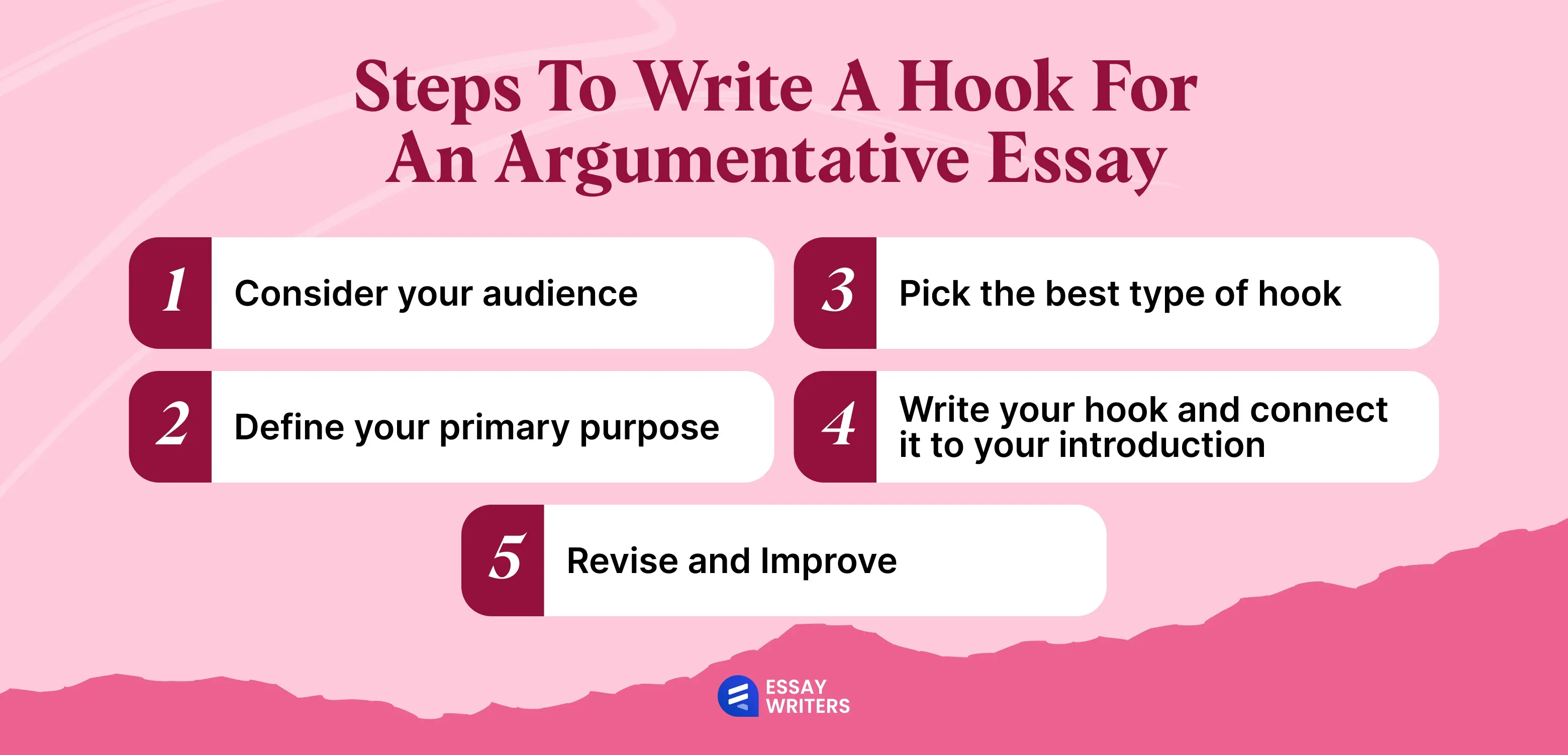
Step 1: Consider your audience
Good hooks for argumentative essays speak directly to your readers and pique their interest. To accomplish this goal, you first need to understand who you are talking to in your essay.
Think about the interests, pain points, and concerns that your audience can relate to. Ask yourself: What language will resonate with them? By understanding the needs of your readers, you can come up with a hook that actually finds a response in them.
Step 2: Define your primary purpose
Secondly, before you can brainstorm effective hook ideas, you need to have a well-defined purpose. The most impactful argumentative essay hooks should logically fit your paper’s content. At the same time, they should leave intrigue, not giving out everything straight away.
Clearly, an argumentative essay strives to persuade the reader of your point of view. So, before writing your hook, you need to outline the central point you want to stand out in your essay.
Step 3: Pick the Best Type of Hook
Look back at the hook types we’ve defined earlier and consider how each variation of a hook for an argumentative essay fits your purpose and audience.
For example, if you are writing on a serious topic meant for a knowledgeable audience, an expert quotation, fact-based statement, or statistical hooks could work best. If you’re writing to entertain, you may want to pick a hook that creates a personal connection, like an anecdotal or descriptive hook.
Step 4: Write Your Hook and Connect It to Your Introduction
Write a chosen type of hook. Make sure to make it relevant, concise, and use valid facts, quotes, and statistics.
Remember that a hook in argumentative essay should logically transition into the rest of the intro. So, after you write yours, create a “bridge” of sentences that narrow down the focus, offer background info for your topic, and naturally connect to your thesis statement. Use transitions like “however,” “in contrast,” and others to link ideas.
Step 5: Revise and Improve
When you draft your hook, let it sit for some time and come back to it with a fresh mind. Read your hook sentence out loud to hear how it flows. Then, edit it for maximum engagement, clarity, and impact.
If you feel stuck at this stage, consider checking out good hooks for an argumentative essay to understand what it should look like and find inspiration. You can find hook examples further in this guide.
Running Out Of Time?
Delegate your academic tasks to professional writers and free your time up for what really matters.


Hook Sentence Examples for Argumentative Essay
As you already know, a good hook sentence should align with three things:
- Your essay’s topic and main argument (you can find fresh and engaging argumentative essay ideas in our blog if you don’t have a topic yet)
- Your audience and its interests
- The type of hook you’ve selected
Although it sounds pretty straightforward, finding perfect hook ideas can be tough. We’ve gathered some good argumentative essay hook examples for each type to help you.
Quotation hook example
“I fear the day when the technology overlaps with our humanity. The world will only have a generation of idiots.” Albert Einstein
Why it works: This is a quote from a very respected and famous person. It might be a little too bold, but it definitely captures attention. It also clearly communicates a stance against over-relying on technology. It could make a good, attention-grabbing hook for an argumentative essay about the adverse impacts of technology on humans.
Question hook example
“How can we be truly happy if we spend more time peeking into other people’s lives than building our own?”
Why it works: This is a rather rhetorical question that encourages people to think critically about the role of social media while instantly making a point that you can’t be happy without focusing on your own life. It can be a good hook for an essay about the impact of social media on our mental health.
Statement hook example
“Earth is warming at a rate not seen in the past 10,000 years, and human activity is the primary cause.”
Why it works: Hook sentence examples like this one are direct, critical, and bold. They instantly hit the audience with truth (often unpleasant), which creates a high degree of engagement. Also, this particular statement is based on valid data taken from the latest findings of a highly respected source, NASA, which instantly adds credibility.
Anecdotal hook example
“It was Christmas Eve. I could hear laughter and smell a delicious aroma coming up from the kitchen, where all my family had already gathered. But I had my nose in the book, and that’s when I realized the social limitations that homework put on students.”
Why it works: This example tells a personal story to create an emotional connection with the reader. Yet, it clearly states the problem and its impact. It’s a great opening for an essay on the cons of homework.
Statistic hook example
“There are roughly 14.9 to 15.2 million vacant homes in the U.S. Yet, the country’s homelessness rate hits a record of over 771,000 homeless people, an 18% leap from the previous year.”
Why it works: Hook examples like this one present the unpleasant truth using raw numbers. It instantly highlights the problem and its contradicting, or even artificial, nature by offering counter-acting statistics. It can be used for an essay on homelessness.
Descriptive hook example
“It’s past midnight. Long after the world has plunged into darkness, millions of teens’ faces are still illuminated by the light of a smartphone screen, making them wander around the virtual world instead of seeing dreams.”
Why it works: This hook example is vivid. It uses sensory details to help readers imagine the setting of an essay. It can be used in an argumentative paper about the negative impact of smartphones on teens’ sleep patterns.
Conclusion
Engaging the audience while keeping the focus on your essay’s topic isn’t an easy task. A hook sentence is meant to help you accomplish it. But you need to know how to write it the right way in order to make maximum impact and set the tone for your paper. And it takes skill and practice to master this art.
After reading this guide, you should have a clear understanding of how to write a hook for an argumentative essay. In short, this process should consist of 5 steps:
- Understanding the audience.
- Defining the purpose.
- Picking the perfect hook type.
- Writing the hook.
- Revising and improving.
You also have definitions of the main hook types and a list of attention grabber examples for argumentative essay. Use the steps, tips, and examples from our guide to inspire your writing and master the art of engaging the readers from the first line of your essay. And remember, our good essay writers are always ready to help.
FAQs
Do argumentative essays need hooks?
A hook isn’t a mandatory requirement in an academic essay. That is, you don’t have to include it. But you want to, if you aim to make your paper truly engaging and memorable. A hook sentence is what sets the tone for an entire essay and grabs the reader’s attention.
What is an example of a hook in an argumentative essay?
There are many hook examples for argumentative essays that actually work. After reading our guide, you have a list of hook ideas for each type, including a quotation, question, statement, anecdotal statistic, and descriptive hook. You can use them for inspiration to write your own hooks and engage the audience.
How to write a hook in an argumentative essay?
Firstly, consider the interests of your audience to know what can resonate with them. Then define the purpose of the essay and pick a hook type that suits it (and your audience) best. After this, write a concise, clear, and engaging hook. Finally, revise and improve it for maximum impact.


