
How to Write an Expository Essay: Everything You Need to Know

If you struggle with writing, there’s nothing wrong with hiring professional help. On EssayWriters, you can find essay writers who will happily help by providing you with a model expository essay template or polishing your draft to perfection. They understand what a good essay should look like and can turn even the dullest topic into an engaging and well-written piece based on your instructions.
That said, expository essays aren’t that hard to write if you’re willing to put in the work. That’s why we’ve prepared a simple step-by-step guide for you. Just follow it, and you’ll nail your essay.
What is an Expository Essay?
An expository essay is an umbrella term for several different essay types (descriptive, how-to, cause-and-effect, etc.) that all have the same purpose: to explain the topic rather than argue a specific stance. The focus of expository essays is facts and evidence explained in a logical, easy-to-follow manner.
Traditionally, expository essays are considered easier to write than argumentative, analytical, or persuasive essays, but this isn’t always true. Sometimes, it’s actually easier to know what to say when you have to defend or deconstruct a specific perspective. Writing neutrally and objectively (which is what expository essays require) can be challenging, too.
Types of expository essays
It’s rare for students to receive assignment instructions that state something along the lines of “you need to write an expository essay.” More commonly, you’ll see a specific type of expository essay, such as:
- A definition essay explains a complex term or concept to help the reader understand it. Definition essays are typically shorter than other types.
- A process essay is similar to a definition essay, except it focuses on describing how something works step by step (for example, how recycling reduces environmental waste).
- A cause-and-effect essay explores why something happens and what the consequences are.
- A compare-and-contrast essay examines the similarities and differences between two or more subjects (for example, public vs. private universities).
- A problem-solution essay presents a specific problem and discusses possible solutions to it.
Even if the type of expository essay you’re expected to write isn’t explicitly stated in the instructions, you can typically understand it from the wording of the prompt.
What’s the correct expository essay format?
The format of your expository essay depends on the citation style you’re using and your assignment instructions. For example, if you’re writing in MLA, there’s no need for a title page – a header with your name, date, and a few other elements is enough. In contrast, if the required citation style is APA, you will need a separate title page.
If you don’t know which citation style to use, we recommend checking the instructions and the assignment rubric. It’s almost always stated there. If not, the best approach is to contact your professor or TA to clarify. Typically, MLA is used in humanities classes, and APA in social sciences, but some professors have their preferences, so this isn’t always the case.
How to Write an Expository Essay Step by Step
If you’ve written an essay at least once, you already have a good idea of what to do. Expository essays might be a little different from other essay types, but this doesn’t affect the writing process much. You still need to research, then outline, then write, then edit.
The only major difference is that you don’t start by choosing a specific stance on your topic. What you think of it doesn’t matter much in expository essays. Ideally, your opinion shouldn’t even come through to the reader. Instead, approach research and writing thinking, “How can I best explain my topic so that someone new to it understands all the ins and outs?
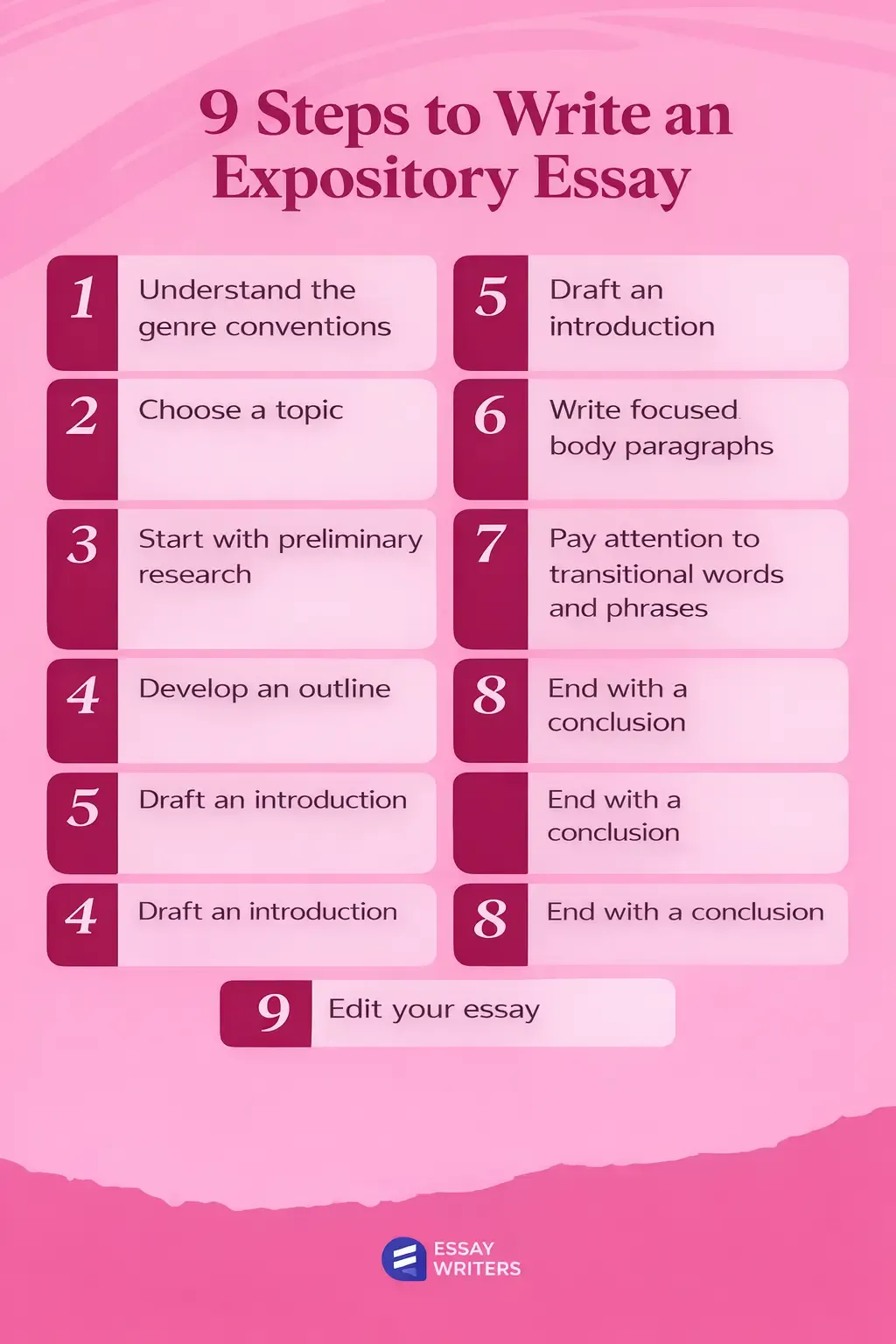
1. Make sure you understand the genre conventions
Many essays may share pretty much the same structure, but this doesn’t mean all essay types are created equal. An expository essay is quite different from an argumentative, persuasive, or even analytical essay. Understanding where those differences lie is the first step.
Start with the definition, and then review a few model expository essay examples. Make sure you understand what’s expected. For example, while in argumentative essays you have to argue a certain stance and convince the reader that yours is correct, an expository essay is supposed to be neutral. Your goal is to explain your topic more or less objectively.
2.Choose a researchable and sufficiently narrow topic
A sure way to make expository essay writing harder than it has to be is to choose a topic so broad that people typically write entire books on it.
No matter how skilled a writer you are, you won’t be able to cover something like the civil rights movement or the history of cinematography in 1,000–2,000 words. If you attempt to do so, your work will end up surface-level and all over the place.
Take a broader topic and then narrow it down to just one aspect or a short period. Also, make sure there is enough credible literature on it, or else you’ll have a hard time backing up your points.
3.Start with preliminary research
Background research will help you define your topic. Leaf through a few textbooks, books, and scholarly articles – and you’ll have a good idea of what to include in your essay and how to organize it to fit all the necessary information.
It also makes sense to select your main literature before you start writing. It will help you avoid the choice overload and the mess that comes with it, especially if your topic is well-researched and you have thousands of sources to choose from. If you realize that something’s missing later on, while writing, you can always add more.
4.Develop a solid expository essay outline
Some essay types call for specific outlines. For example, every argumentative essay requires at least a couple of paragraphs where you acknowledge and refute counterarguments.
That’s not the case with expository essays, though. All you need is to follow a very basic essay outline:
- An introduction, which includes a hook, some background information, and a strong thesis statement
- A few focused body paragraphs with relevant evidence and analysis
- A concise conclusion where you restate your key points and add a closing thought.
Just make sure that your structure matches the type of expository essay you’re writing (compare-and-contrast, cause-and-effect, etc.).
5.Draft an introduction with a working thesis
How to write an expository essay introduction? Pretty much the same as any other essay introduction, which consists of three key elements:
- A hook – an interesting fact, unexpected statistics, or anything else that you think might grab your reader’s attention from the get-go.
- Background information, where you give your reader a bit of context to make sure they understand what they are about to read.
- A thesis statement, which is the main idea that you’re about to explain in your body paragraphs.
At this point, it’s okay if your thesis is in its draft state. If your writing process takes you into a slightly different direction than what you expected, you can revise it later.
6.Write focused body paragraphs with clear topic sentences
Now comes the most time- and effort-consuming part of writing an expository essay – writing your body paragraphs (which make up roughly 80% of the total word count).
If you didn’t try to cut corners when outlining, you shouldn’t have any problem putting your ideas into words. Just remember to follow the TEEL formula in each body paragraph:
- Topic sentence, meaning the first sentence, where the main idea of the paragraph is expressed clearly and to the point
- Evidence – a relevant fact, a quote from a credible source, an illustrative example, etc.
- Explanation or analysis of evidence
- Link (transition to the next paragraph).
7.Pay attention to transitional words and phrases
Many beginner writers make the same mistake: they treat each individual body paragraph as a semi-separate piece, where they fully develop a certain idea without then bringing everything together once they’re done.
Each body paragraph should indeed be focused and cover just one idea. However, for your essay to be coherent, that’s not enough. You also need to include transitional words and phrases that make the entire essay flow well.
Transitions belong both inside the paragraph, where they help you connect your evidence with analysis, and between paragraphs. Aim for a good mix of transitional words (e.g., however), phrases (e.g., in contrast), and logical transitions that are built into the flow of your ideas.
8.End with a conclusion that wraps up your arguments
Another common question is how to write a conclusion for an expository essay. Again, it follows basically the same formula as conclusions for any essay type.
First, you restate the thesis statement without repeating it word for word: remind the reader what you’ve just explained or proved. Next, briefly (in just a few sentences) summarize the key points from your body paragraphs.
Finally, end your essay with a broader closing thought. It can be a short reflection on why your topic matters, the real-world implications of what you’ve just explained, or anything else that will hopefully make the reader think about your essay even after they’re done reading it.
9.Edit your essay – but only after you’re done writing it
Now, all that’s left to do is to revise, edit, and proofread your work.
A pro tip: don’t edit while you’re writing. It’s tempting to rewrite the same sentence over and over until you get it perfect, and many writers fall victim to this. However, you’ll spend much more time on your essay this way. A much better strategy is to follow the principle, “the only task of your first draft is to just be complete.” You’ll have ample opportunities to polish it once it’s fully written.
Also, it helps to change your font when revising, especially if you don’t use any proofreading tools. It’ll help you spot mistakes and typos more easily.
Struggling with your expository essay?
Get professional help with organization, research, and strong academic writing.


Conclusion
You now have a guide on how to write an expository essay step by step. Follow it, and you’ll finish your essay fairly quickly, especially if you outline diligently first. A good, detailed outline shortens the writing time significantly.
To help you further, here are a few actionable tips for finishing your essay:
- Gather the literature you’re going to cite before you start writing and stick to your first list of sources unless you absolutely need to find something else.
- Your first thesis statement is just a working thesis. You can revise it later if writing takes you in unexpected directions.
- Don’t edit your work while writing – edit once your first draft is fully done.
- Ask someone else to read your essay before you make the final edits. A fresh set of eyes helps spot logical inconsistencies, breaks in the flow, and lacking transitions.
Good luck!
FAQs
What’s the purpose of an expository essay?
An expository essay explains or clarifies a topic more or less objectively. Unlike in some other essay types, your opinions shouldn’t be explicit in expository writing. The goal is to only inform your readers. Also, the type of your expository essay (cause-and-effect, compare-and-contrast, etc.) matters and defines its main purpose.
What are good ways to start an expository essay?
Some of the good ways to start an expository essay are a surprising fact, an unexpected piece of statistics, an anecdote, or a quote. Don’t overdo this, though. While essays need hooks, too, they are not the same as speeches. Consider the context, topic, and instructions: a joke or a fun fact isn’t always appropriate in academic writing.
What should an expository essay thesis look like?
The thesis statement of an expository essay should state the central idea or claim of your work, ideally, in one sentence. Don’t write something like, “This essay will show…”, as this is considered lazy. Instead, connect your introduction to the thesis statement logically and just state the main idea.
How long should a standard expository essay be?
Depending on the instructions and topic, an expository essay can be as short as 500 words or as long as 2,000. Longer expository essays are less common, but make sure to check the rubric or contact your professor if in doubt.


