
How to Title an Essay: Top Tips and Samples From Pro Writers

Essay writing is filled with challenges. Understanding the prompt, coming up with a viable topic, doing your research, and crafting a compelling and original essay – each of these steps can cause frustration. And then, there is also proofreading, editing, formatting, and other added issues that make things even more complicated.
Luckily, you don't have to struggle with it on your own. Essay Writers is a platform students can rely on for all kinds of essay support. Our experts craft outstanding papers to let you save your time and provide academic guidance in our blog to help you study more effectively.
In this guide, we'll focus on one part of an essay that's often overlooked but incredibly important – a title. We'll tell you how to come up with a title for an essay that grabs attention and presents your topic well.
What is the Purpose of an Essay Heading?
An essay title is a small but crucial part of your paper. It performs several crucial functions. Firstly, it tells the readers what your paper is about. This should help them understand whether they are interested in reading your essay or not. Or, if they come across it while doing research, your title should signal whether your work is relevant to their field.
Secondly, a title should capture attention. It should give a general sense of what your essay is about without giving it all out, sparking the reader's curiosity and encouraging them to read further. This might not be your top priority if you're writing a casual essay for the classroom. However, if you are writing it for a contest or college application, a heading that captures attention is pivotal for success.
Long story short, the purpose of a title is to inform and engage the reader. Now, let's talk about how to create a title for an essay that accomplishes these goals.
How to Write a Title in an Essay: A Step-by-Step Guide
A title is the first thing readers see in your essay. Respectively, the success of the whole work depends on it a lot, although many students tend to overlook its importance.
So, what makes a good heading? It should have the following characteristics:
- Conciseness
- Clarity
- Matching tone
- Proper formatting
At the same time, it has to pique the readers' interest and align with your paper's content. So, how to make a title for an essay that has it all? Below, you will find a detailed guide with expert tips that will set you on the right track.
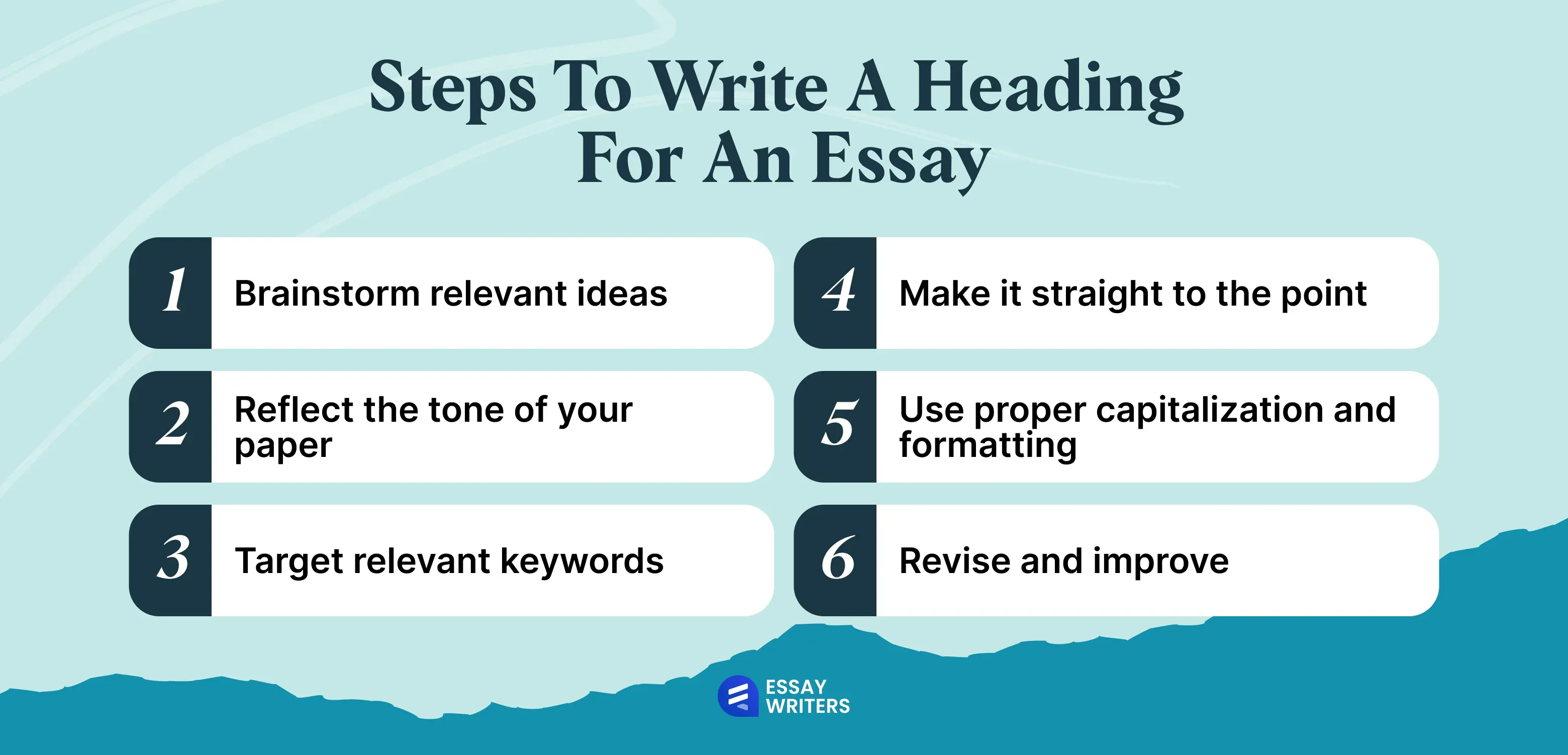
Brainstorm relevant ideas
Take some time to brainstorm ideas. It looks similar to creating a great hook for an argumentative essay. Think about the concepts and phrases that align with the subject of your paper. Try looking at the topic from different perspectives to find a general topical direction for your title that aligns with the essay.
Pro tip: Never bother about how to come up with a title for an essay before you complete the essay itself. Your title should become the quintessence of a paper.
Reflect the tone of your paper
A good title for essay should clearly mirror your essay and the topics it explores. To emphasize this connection, it should also fit the general tone of voice in your paper. So before you start writing it, determine the tone of your essay. It can be:
- Formal
- Persuasive
- Informal
- Informative, etc.
In many cases, the tone will align with the purpose and subject of your paper.
Target relevant keywords
This isn't a typical tip you will come across when seeking ideas for a title for essay. But it works. Keywords are basically the main words that communicate the topic and purpose of your essay. Choosing one or a few can help you create a very focused title.
Besides, this will help if you plan to publish your paper on the web. Relevant keywords ensure that it ranks in search engines and people find it.
Make it straight to the point
Although it should capture the main idea of a paper and engage the reader, a heading is just a heading. Its core purpose is to name your essay, and not to give out all the information about it.
Then, what is a good title for an essay? It's concise and straight to the point. Limit it to 10 words and reflect on the most important details of your paper. Then, revise it for clarity.
Use proper capitalization and formatting
After you draft a heading for essay, you need to format it correctly. The exact formatting will depend on the style guide you follow in your essay, such as APA, MLA, etc. Be sure to clarify the formatting and capitalization rules of your style and adjust your title accordingly.
In most cases, you will use Title Case, in which you capitalize all major words, except for articles, short conjunctions, and short prepositions (unless they stand at the beginning or end of the title).
Revise and Improve
When you have your essay heading ready, set it aside and reread your paper. You want your title to align with the final draft. Additionally, check it for grammar, punctuation, clarity, and engagement. It's important to polish the title to perfection so that it doesn't spoil the reader's first impression.
Pro tip: Check out our detailed editing checklist to revise your title (and essay) step by step and not miss out on anything important.
Stuck on Your Essay Title?
EssayWriters is here to help all the way from picking a topic to writing the final draft.


Mistakes to Avoid in Essay Titles
- Now that you know how to title your essay, you also need to know about some don'ts that can ruin the heading. Here are the key mistakes to avoid:
- Making the title too vague or generalized. Focused and straightforward headings help you avoid confusing the reader.
- Not hinting at what the reader will find in the paper. When the title contradicts the content of a paper, it's misleading and disappointing to readers.
- Making the title too long or providing too much detail. If you are wondering how to name an essay the right way, make it concise and leave some intrigue.
- Stuffing the heading with filler words and clichés. These add unnecessary length and draw attention away from the most important points.
- Inserting jargon and acronyms. Using terms like these can confuse readers who are not very knowledgeable about your topic.
- Inserting repetitive words. This makes your heading less readable.
- Using negative or controversial terms. Overly negative language feels like you're trying to impose your opinion onto the reader aggressively instead of giving them a chance to make their own conclusions.


Essay Title Examples From Seasoned Writers
Even when you technically know how to make a good title for an essay step by step, it's still okay to face challenges and not know where to begin. The heading has a huge importance for your essay. So, naturally, you don't want to get it wrong.
To help you get rid of doubts and inspire your writing, we've prepared a few title examples for different essay types. Check them out to see what a good title looks like:
Personal essays
A personal essay is a short piece that reflects on your personal life. Usually, it explores a personal challenge, turning point, or another important stage in life and is written as a part of a college or scholarship application.
A title for such an essay should grab attention and reveal what the story is about. Here are the bad and good examples of a heading:
❌ Bad: "How I Failed." The title is flat and not engaging.
✅ Good: "The Mistake That Shaped My Best Self." The title also reveals that the essay is about a failure, but emphasizes growth and captures attention.
Expository essays
An expository essay is a paper that defines or elaborates on a topic without giving a personal opinion. This kind of paper is very informative and fact-based, which is why it's typically used as an academic assignment.
A title for such an essay has to be clear, focused, and highly relevant. Here are a few examples to consider:
❌ Bad: "Feedback in Schools." The title is too vague and doesn't explain the purpose of the essay.
✅ Good: "The Role of Teacher Feedback in Long-Term Academic Success." The title gives more context; it's specific and clearly states the purpose of writing.
Narrative essays
A narrative essay is a piece that shares a story. It has a distinct personal voice, storytelling elements, and emotional tone. It might be used in academic writing, as well as applications and contest essays.
A title for such an essay should be personal and engaging. It can also emphasize the moment, conflict, or lesson from the story. Let's look at examples:
❌ Bad: "An Important Turning Point." The title doesn't show the essence of the story.
✅ Good: "The Change in My Life After the Door Closed." The title uses the "show, don't tell" rule and sparks curiosity.
Descriptive essays
A descriptive essay is a piece that describes a person, an event, etc. Its primary distinctive feature is the use of sensory details and the approach of "showing" instead of "telling." It's commonly used in academic writing and essay contests.
A title for such an essay should be vivid and engage the reader's imagination.
❌ Bad: "My Childhood Home." The title doesn't use sensory details and is too plain. It fails to engage.
✅ Good: "The Place That Smelled Like Childhood, Family, and Laughter." The title engages, evokes emotions, and sets the right tone.
Read also: How to end a college essay
Let's Recap
A title is sometimes an optional part of an essay, especially when the word count is limited. Yet, it's an important element that gives you a chance to engage the reader, set the scene for your essay, and become memorable.
A good heading has to be relevant, descriptive, concise, and original. Most importantly, it has to be engaging and logically frame your essay, matching its tone and topic. And, as you now know, it should also align with the type and purpose of an essay to make the best impact.
So, how to create a good title for an essay? It only takes five steps:
- Brainstorm ideas
- Define the tone
- Consider keywords
- Make it concise
- Implement proper formatting
- Revise and improve
Use the steps and tips we shared in this guide to master the art of crafting impactful essay titles.
FAQs
Does an essay need a title?
A title isn't always mandatory. It's often required for academic papers, unless the instructions state otherwise. However, it might be optional for college essays due to the limited word count. Yet, a title in an application essay gives you extra space to frame your essay and capture attention. So it's often recommended to write one.
What is a good title for an essay?
A good title needs to be descriptive and tell the readers what they will find in an essay. It also has to be relevant to the topic, clear, and concise. At the same time, it has to be original and pique the reader's curiosity to encourage them to read the paper.
What should you consider when writing a heading for an essay?
You need to consider the topic and tone of your essay. Formatting and capitalization are also important to observe to ensure that you meet the general paper requirements. Optionally, you can add relevant keywords to your title. They can help you maintain focus on the topic and ensure the discoverability of your essay.
What are common formats for essay titles?
The correct formatting depends on your essay's requirements and style guide. Commonly, you will use MLA or APA style. As for the general format, essay titles often use Title Case, are centered on the page, and are double-spaced. To get formatting right, carefully read the instructions you have and stick to them.


