
How to Write an Analytical Essay: Your Step-by-Step Guide

If you know that essay writing isn’t your strong suit, it’s never a bad idea to get professional help for your analytical essay. Experts you can find on our essay writers website have written thousands of analytical essays and know exactly what it takes to wow any reader. You’ll get an essay that answers your prompt perfectly and follows every requirement from your rubric.
But if you feel confident in your own writing skills, why not give it a shot? We’ve prepared a detailed step-by-step guide that will help you write a perfect analytical essay – even if it’s your first time doing it.
What is an Analytical Essay?
An analytical essay is a genre of academic writing that examines a problem (or, in some cases, text) from a specific angle to understand how its elements work together and why it matters.
If you think that this analytical essay definition sounds somewhat vague, that’s because an analytical essay is an umbrella term. Cause-and-effect, compare-and-contrast, interpretation, process analysis, and a few other essay types can all be considered analytical essays. Which of them you should choose as the blueprint for your essay depends on the prompt.
However, unlike expository or narrative essays, an analytical essay should always acknowledge the opposite point of view and intelligently debunk it. That’s part of the analysis.
Proper Analytical Essay Structure
The structure of an analytical essay is similar to most other essay types. It includes four core elements:
1. Introduction. This is where you give the reader the necessary context for understanding your topic, show why it’s relevant, and clearly articulate your main argument in a well-constructed thesis statement.
2. Body paragraphs where you argue your stance. All body paragraphs should have a straightforward topic sentence and focus on only one point or argument each. They must also include relevant evidence followed by critical analysis.
3. Body paragraphs where you address and refute the counterarguments. No analytical essay is complete without at least one or two paragraphs where you acknowledge alternative perspectives on your topic. Your task is to show why your stance is superior using data.
4. Conclusion. This is where you restate your thesis, summarize your key arguments, and finish your essay off with a final insight that makes the reader feel like your essay has effectively clarified something to them.
How to Write an Analytical Essay in 6 Steps
Mastering analytical essays can take some time and practice, but it’s perfectly doable – especially when you have clear directions. We wanted to help you do a good job on your essay, even if you’ve never written one before.
That’s why we developed a six-step guide that outlines everything you should do to end up with a great analytical essay. Just follow our directions – and you won’t have to ponder on what you should do next. With time, you won’t even need it anymore.
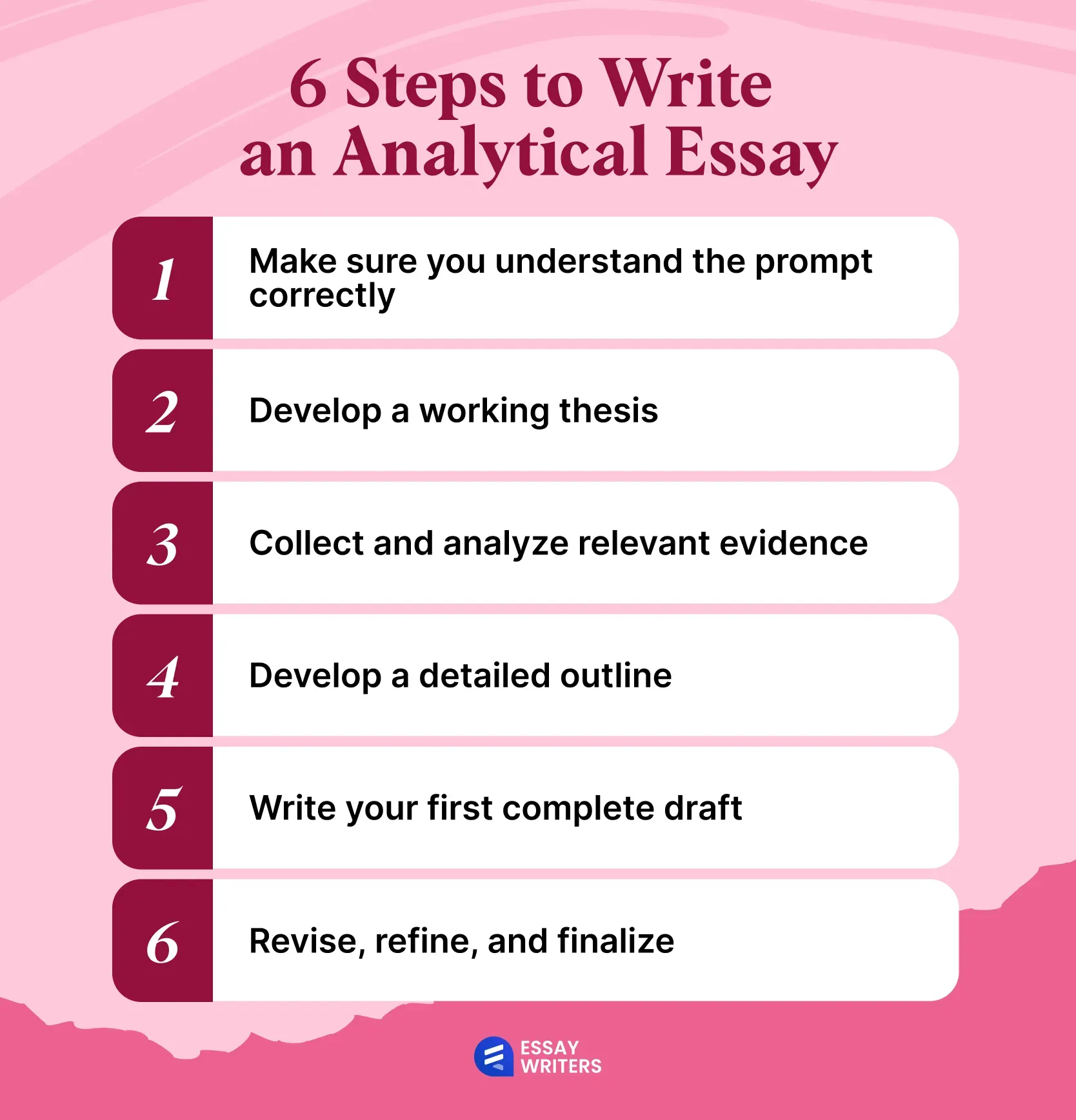
1. Make sure you understand the prompt correctly
Even the best-written analytical essay won’t get you a good grade unless it follows the prompt. Many mistakes in essay writing could be avoided if the author had read the instructions carefully a few times and taken their time to understand what’s expected.
In fact, a prompt is the best source of guidance for your essay. More often than not, it contains hints that’ll help you decide how to structure your work and what to focus on.
For example, if you see such phrases as “what caused” or “how … came to be,” it means that your professor expects a variation of a cause-and-effect essay. You’re expected to analyze what factors contributed to the problem you’re writing about and what the outcomes were.
In contrast, if your prompt includes words like “judge,” “assess,” or “evaluate,” you need to write an evaluation essay that explicitly states your take on the problem – backed by compelling evidence, of course.
Analytical essays come in different forms, including cause-and-effect, compare-and-contrast, interpretation, process analysis, problem-solution, and many more. Pay attention to the prompt, and you’ll know which angle to take in your writing.
If you struggle to understand the prompt, it’s always best to ask your classmates or, even better, contact your professor for clarification.
2. Develop a working thesis (you’ll revise it later)
Once you’re sure you understand the angle set by your prompt, you’ll need to come up with a working thesis statement to have a specific direction for your essay.
Don’t stress over making it perfect. At this point, your thesis is in its draft state: it keeps your writing focused and helps you develop a clear argument, but it can be revised later on. For example, if your stance on the problem changes when you analyze relevant literature, you can rewrite your thesis and adjust the structure of your essay.
A thesis might be the shortest element of an essay, but it’s arguably the most important one. If you check the rubric for your assignment, you’ll probably find that the thesis alone “weighs” a few points. No other individual sentence in your essay carries the same significance.
To help you develop a strong thesis, here are a few critical characteristics of a thesis for an analytical essay:
- Specific, meaning it states exactly what will be analyzed
- Arguable, which implies that your claim isn’t a fact; it’s debatable
- Analytical instead of descriptive, meaning it focuses on why and how, as opposed to just what
- Guides the essay so that the reader can instantly see the direction of your argument just from the thesis alone.
3. Collect and analyze relevant evidence
After you have a working thesis that’s clear, focused, and directly answers the prompt, it’s time to review relevant literature to collect enough evidence.
The main reason why you need a thesis before you dive into research is to give your research a specific direction. The amount of relevant literature for certain topics is so massive that, without a more focused, narrowed stance, it’s easy to get overwhelmed. The central argument of your essay, which is expressed in your thesis, is an effective filter for your research.
Where to look for credible sources for your essay depends on the subject and topic. However, it’s always best to start with Google Scholar or academic databases like JSTOR, PubMed, and ERIC, among others. Also, make sure to consult with the rubric for your essay: sometimes, it contains explicit requirements for the sources used (for example, that they have to be peer-reviewed).
We also recommend taking notes and highlighting relevant quotes that you intend to use for your essay while you’re doing your research. This will make the process more organized and save you time. During the next stage, outlining, you’ll be able to include all relevant quotes and citations exactly in the paragraphs where they belong.

4. Develop a detailed outline
A good outline is more than just a list of bullet points you intend to cover in each paragraph. When done diligently, outlining is supposed to take up to 30% of the overall time spent on writing an essay.
Many students skip outlining or do the bare minimum, hoping to cut the time. But it doesn’t work this way, unfortunately. Unless you outline thoroughly, you’ll spend twice as much time writing your essay.
So, what should an outline for an analytical essay include for it to be actually helpful?
- A strong introduction with an effective opening and relevant context, followed by your problem statement and a thesis.
- Draft topic sentences for all body paragraphs that clearly state the argument covered in each of the paragraphs.
- Relevant quotes and evidence to back up the arguments from your body paragraphs, followed by in-text citations. A pro tip: even if you write in APA, include page numbers; you can delete them later. They’ll help you avoid losing your data in the pile of evidence you’ve collected – this happens a lot.
- Counterarguments with strong evidence, followed by effective refutations. An analytical essay always requires acknowledging the opposite stance, or else it’s incomplete.
- A draft conclusion that restates your thesis and summarizes your key arguments. Just a draft is enough at this point.
5. Write your first complete draft
Believe it or not, if you invest enough time and effort in developing a thorough outline, actually writing your essay isn’t hard. All you need to do is properly articulate and connect all the points you included in the outline. Your main task at this stage is to make sure your central argument is easy to follow and your writing flows well.
Still, there are a few things to pay particular attention to:
- Check your thesis statement to ensure it isn’t misleading. Revise it as many times as necessary until it perfectly captures the main thing you’re arguing in your essay.
- Review all transitions, both within the paragraphs and between different paragraphs. An abrupt transition from one point to another can make an essay hard to follow and weaken your argument.
- Triple-check your quotes and in-text citations. A seemingly minor honest mistake, like misattributing the data, can lead to penalties for plagiarism.
- Put some thought into how you finish your essay. An effective conclusion should draw a line after everything you’ve argued and leave the reader with a clear understanding of your stance.
Also, be prepared to change certain wordings and rewrite a sentence here and there when refining your draft. Don’t get too attached to specific phrases.
6. Revise, refine, and finalize
Once you have your first draft, all that’s left is polishing your essay. But this doesn’t mean that you can just gloss over your editing. It doesn’t matter how skilled a writer you are and how helpful Grammarly’s browser extension is – you’re guaranteed to miss something unless you read your essay a few times, paying close attention to every element.
A pro tip: when we look at the same text for too long, especially if it’s ours, our ability to catch its imperfections drops. It’s easy to miss something, from a simple typo to a logical gap in reasoning. It sometimes helps to change the font you write in (for example, from Arial to Times New Roman or vice versa). It might help you notice something new.
Also, don’t underestimate the power of a second pair of eyes. If you have anyone to show your essay to before submitting it, you should absolutely do it. Even if this person knows nothing about your topic, they might still be able to assess how well your arguments flow and how compelling your work is overall.
Finally, don’t forget to run your essay through a couple of plagiarism checkers and AI detectors. With how strict schools are about academic integrity these days, this step is a must.
Where to Find a Good Analytical Essay Example
If you are looking for a reference for how to structure your work, there’s no shortage of analytical essay examples online.
However, please be careful when trusting them blindly. Some of the samples that come up in the top Google search results are written by beginner student writers like yourself, or even by AI. Not all of them are good and worth using as a model to follow.
For inspiration, read Is Google Making Us Stupid? by Nicholas Carr, published in The Atlantic. It’s not an academic work, but Carr’s level of analysis is exceptional.
Analytical essay due soon?
Save time and avoid stress — get professional support with analysis, structure, and academic writing.


Common Mistakes in Writing an Analytical Essay
Different writers make different mistakes, but here are some of the things you need to be particularly mindful of when working on your analytical essay:
- A weak or overly generic thesis statement
- More summary than analysis
- Insufficient or poorly analyzed evidence
- Unacknowledged or glossed over counterarguments
- Overuse of direct quotes.
Of course, this list isn’t complete, but we recommend using it as a checklist. Once you’re done writing your first draft, check your work for these mistakes.
Conclusion
By now, you should have a good idea of how to write analytical essay. Regardless of the topic, you should follow our step-by-step guide:
- Carefully analyze the prompt to make sure you understand it correctly.
- Draft a clear and focused thesis statement.
- Gather evidence from credible, preferably peer-reviewed sources.
- Put enough thought and effort into developing a detailed outline. Don’t forget to cover counterarguments – they are critical for an analytical essay.
- Write your first draft.
- Revise your work and check it for plagiarism and AI. If possible, ask someone to read it and give you their feedback before submitting your essay.
Finally, to avoid the same mistakes many students make when writing analytical essays, use our checklist. Good luck! We believe in you – you’ll nail it.
FAQs
What’s the purpose of an analytical essay?
As the name of the genre suggests, the purpose of an analytical essay is to critically examine and analyze your topic. This implies breaking the topic into focused points and going through them one by one (including counterarguments!). You need to interpret the evidence and show how all of the elements you write about work together.
How to start an analytical essay?
Every analytical essay should start with a little context and a clear problem statement. The context should give your reader an idea of what your essay is about. The problem statement must clearly answer the question of why your topic matters. End the introduction with a clear thesis that effectively summarizes the central argument you’re making in your essay.
What are the four parts of an analytical essay?
The four parts of an analytical essay are: 1. an introduction (ending with a thesis statement); 2. several body paragraphs where you cover different aspects of your topic, with evidence and analysis; 3. a couple of paragraphs with counteranalysis, where you acknowledge and effectively refute the opposite stance on your topic; 4. a conclusion.


